Sunday, July 4, 2010

A Capital 4th

Washington in July - who can say no to that? A clear blue sky, the sun sparkling on the Potomac, all those glorious museums on the Mall, and then in the evening, the redbrick delights of Georgetown.
Sarah rocks.

The first time I came here was for a strained November afternoon, and we took a tram  tour to all the sights. The second time was in the depths of a bitter December, and we saw Colbert's portrait and C3PO, and the chilling Holocaust museum. And Dan from the Amazing Race. YAY.
It's hot now, though. Begin with Lincoln, it's the only way.
The best bit of Washington is the Mall. The museums up and down it are all different, all wonderful in their own way. It's neat. They don't try to out-do the Met, they explore the past, and the arts from a different perspective. The Air and Space Museum is perhaps the busiest, the American Indian Museum the oddest, with some really funky food served in their waterside restaurant. I'm talking sauteed cucumber. This is the subway. Looks like Trump meets the Pantheon.
But away from the Mall there's other stuff to see, still part of the Smithsonian - like the Renwick, which is somebody's house converted into an art gallery, but stil retaining that rich party-just about to start atmosphere. Here and in New York in the past months, I've seen so many nudes reclining, resting and generally hanging out, which makes this piece by Karen Lamonte all the more exceptional.

I'm no patriot, but we watched the parade snake by for an hour or so in the oven of the mall, appropriately enough just outside the American History Museum

After a bit, we had enough, and went to the Freer. Cool, silent. Whistlers, and other masterpieces, with the promise of fireworks to come in the night.
Bliss.

Sunday, June 20, 2010

Canaletto

When Max and me went to see the P&O.
Caution: this video contains information of an educational nature.

Thursday, May 13, 2010

Big Bambu


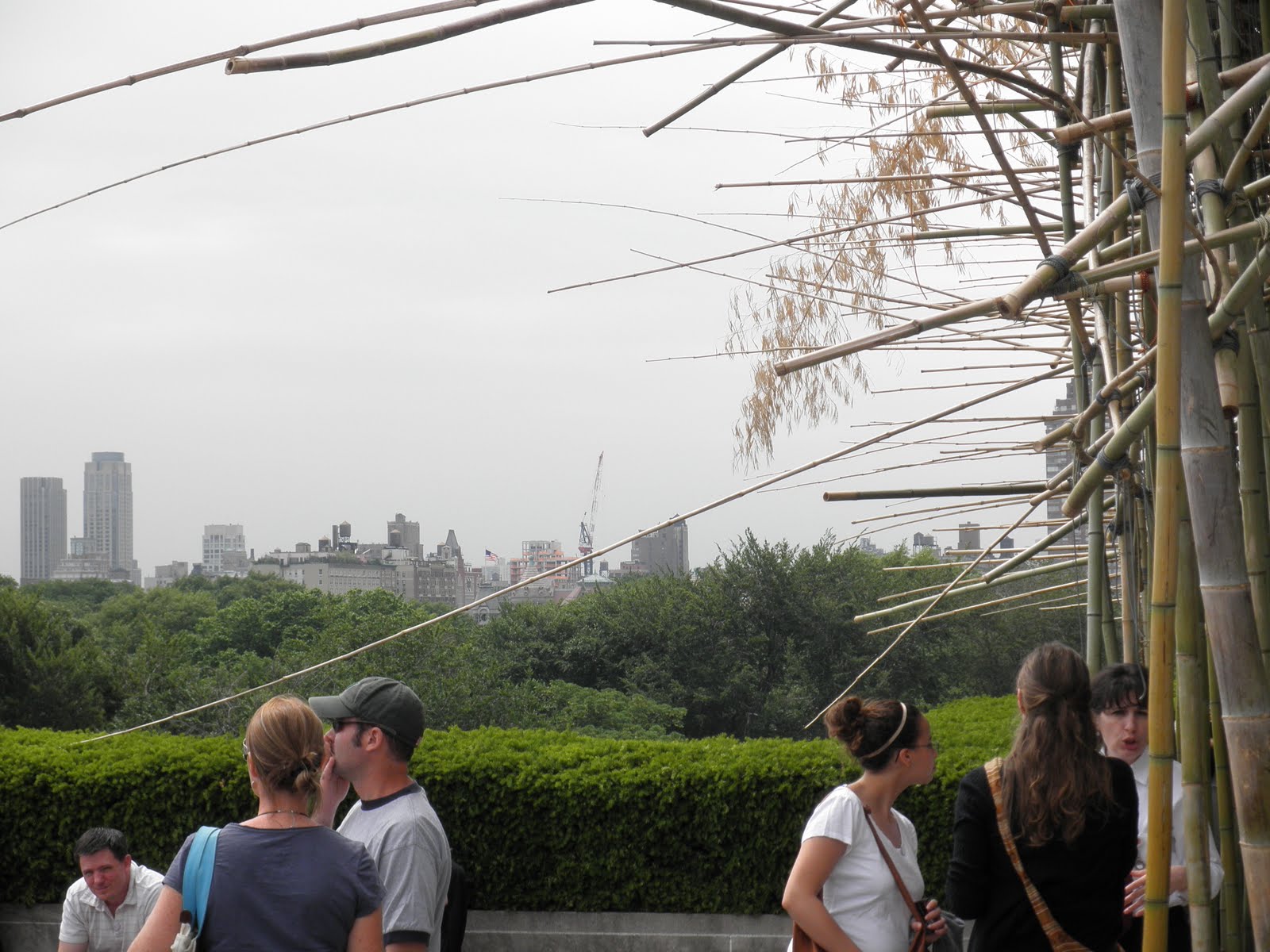
At the Metropolitan Museum in New York, the roof has become a rain forest, overlooking the soft green woods of Central Park. Nestling on among the concrete and brick of the fourth floor courtyard, bamboo poles crowd and cluster, forming a sort of stilted cocktail party, alive with anticipation.
 This is Big Bambu. At floor level, it's a labyrinth of slim pillars, but look up a little, and Big Bambu becomes a bird's nest, full of complicated, chaotic intersections. There is no symmetry in the tangle of poles, but somehow the eye finds patterns, geometric harmonies in 3D. Doug and Mike, the Starn twins, support and direct the overall look of the sculpture, which started as an idea some 13 years ago. Previous to getting permmission to nestify the Met, they built an incredible indoor bamboo arch at their studio at Beacon, just to show the possibilities of both the materials and the techniques they had in mind. The interior pathway  made and reminded me of the voliera in Parco di Monza, but while that structure from 2006 is showing signs of decay, Big Bambu is the Voliera taken flight; bright, busy and still growing: how apt Big Bambu's tagline You Can't, You Won't You Don't Stop. 
But with typically light touch, Doug and Mike have not micromanaged their builders, who are mountain climbers, not professional scaffolders or artists. The brothers set goals to reach, marked on the ground, and then the guys branch out, knot by knot, pole by pole, to reach them.
This is performance art: every move has to be calculated, small engineering quandaries must be overcome, either in private moments of calculation, or with the help of the rest of the team. The result is a unique knitting together of individual solutions to the shared problem of how to get there from here... Big Bambu is an allegory of the city that surrounds it, already complete but never finished, worked out in flows and currents that you have to be inside to really appreciate.

Bamboo is used in the Far East for scaffolding, and it's resilient, light, flexible and forgiving. The dozen or so helpers who work each week on the Starn's project were chosen for their ability with 'methodical knots' (each brightly colored, Swiss-made 'bootstrap' takes about three minutes to tie just right) and with a head for heights. Both talents are essential: the structure is currently 20 feet tall but will soon tower some 40 to 50 feet above the rooftop.
Most visitors only get the roof-level effect of the build, many don't even notice the winding paths that run up into the sky, and the gaping hole at the center,  but for a lucky few, there's a chance to climb up into the structure and to do so just before sunset is the best. During the summer, on Friday and Saturday nights, the roof of the Met is open until sunset, and fills with visitors enjoying a cocktail, company, and the view.
 This is Zac, one of the builders, and also a guide on the Big Bambu tour. 'You're with the elements, up here. There's a feeling of complete happiness working on this project, working steadily as a team, with the wind making the canes rustle and sway a little, you feel interconnected with all the sounds, with the feel of weather as it changes, withe the work of the people around you.Big Bambu is like a cresting wave, when you get up top, you can see the overall form the Starn brothers have in mind. It's like the jungle and the ocean coming together.'
So far, thousands of strings, and more than 4000 poles of varying sizes have been gradually  hauled up onto the roof for use on the structure: 'We're rocking the domestic bamboo,' Zac said, 'All of it comes from South Carolina and Georgia.' With the exception of sensible things like making the walkway complete and safe for visitors, they try to build in such a way that it is not necessary to cut the poles down to size; they'd rather work with the dimensions and use them to invent and suggest new departures for the construction.
It's not until you climb inside the structure, however, that you really get the feel for it. Groups of 15 (the number of people who can be transported in a single elevator from the ticket office in the basement up to the 4th floor) are let in through the bamboo gates and up the narrow walkway. Like corpuscles moving through an artery inside a great beast, our feet and hands interact slightly nervously with the springy interior. 'It's not often an artwork can make you a little afraid,' Zac comments. This is New York, the whole thing has been subjected to all kinds of safety tests, but the feeling of being on the edge remains. You can't carry a camera - or anything else you might drop on the visitors below - up into the sculpture, so no pictures, sadly, but it would be impossible to capture the sensation of being a part of this build, connecting with each  beam, with each builder, and in a new way with the city at out feet.

Wednesday, July 15, 2009

braided

Nel tardo '400, il duca Galeazzo Maria Sforza, papà della favolosa Caterina Sforza e appassionato di musica, radunò a Milano uno straordinario gruppo di musicisti e cantori, strappandoli, con la promessa di lauti guadagni, alle migliori corti italiane ed europee. Per il castello sforzesco, roccaforte e regia, fece progettare dall'architetto toscano Benedetto Ferrini la Cappella Ducale con affreschi eseguiti nel 1473 da un gruppo di artisti tra cui Bonifacio Bembo, Jacopino Vismara e Stefano de' Fedeli. Venne realizzato un ambiente con le pareti dorate, mentre sulla volta è una più complessa decorazione, con la Resurrezione e l'Ascensione di Cristo. Galeazzo ebbe poco tempo per godersela. Meno di tre anni dopo, il giorno di santo Stefano, sulla soglia della chiesa di santo Stefano, venne pugnalato a morte da un gruppo di nobili. Aveva solo trentadue anni.


Durante varie occupazioni straniere, la raffinata cappella viene adibita a stalla, subisce gravi danni alle pareti e naturalmente anche agli affreschi, è stata ripristinata e restaurata agli inizi del Novecento. Ci sono altre opere in questa stanza, ma la protagonista assoluta è la Madonna del Coazzone.

Non è certo l'unica donna 'di spicco' nella galleria. Il busto detto la Mora, una signora riccioluta vestita in una sontuosa camicia, è la fiera occupatrice della stanza dove è situata la Rondanini Pietà, è più giovane e più bella.

Ci sono le donne del gonfalone. Inoltre, questo sarcofago trecentesco sfoggia l'immagine di quattro donne splendide, simboli della giustizia, la scienza, il potere e la religione. Le donne contano.
Conta la Maddonna del Coazzone. Opera di Pietro Antonio Solari (responsabile nel 1482 per i lavori alla Certosa di Parma), fu eseguita circa un decennio dopo il termine dei lavori nella Cappella Ducale. Solari, ticinese, in seguito fu chiamato alla corte dello zar Ivan II e muore a Mosca nella primavera del 1492.
Vista controluce, lei occupa la stanza ora come una regina, ora come una semplice supplicatrice. Prende la luce lombarda che entra dal cortile attraverso una finestra enorme e la rende serena, pura. La statua in marmo (destinata in origine per la Fabbrica del Duomo) rappresenta la Vergine come una dama quattrocentesca assorta in preghiera. Tipico del periodo l'acconciatura dei capelli, annodati nella lunga treccia, detta "coazzone" in dialetto lombardo. Nella sua stanza azzura, una delle ultime che si incontra durante la visita, la statua ci parla del passaggio del tempo e le sofferenze subite, ma con una dolcissima rassegnazione che solo le pietre possono esprimere. Le manca un braccio, ma le sue mani unite sono illese, come la fiducia in una preghiera esaudita.

Ho voluto disegnarla, a modo mio, nella cappella silenziosa, in una giornata di caldo intenso, ho voluto renderla sulla carta, ma non ho saputo catturare la gioventù del volto, la misteriosa tranquillità della sua casa, la leggerezza del suo sguardo contro il peso di quella treccia. Ma cia siamo tenute compagnia per un po' e per questo non la posso dimenticare...

Friday, July 10, 2009

Navigation

Venice doesn't have the monopoly on canals in Italy, you know.
This is the Naviglio Grande, by the darsena or port of Milan in the southwest corner of the city. I took a trip on the water on this nice boat, piloted by a stylish lady all in white, the other weekend.
The industrial heritage of the Navigli is protected nowadays, in classic Italian style, with lots of attention to artistic detail and but slightly confused in its more practical elements. This was the nice arty courtyard where the canal protection people have their offices and sell original watercolours too.
Milan is Venice backwards. Man-made waterways through the ocean of fertile fields and factories of Lombardy, rather than man-made islands in a lagoon: but the point is the same, to make money.
Unlike Paris or London, or even Rome and Turin, Milan's rivers are nothing to write home about; the Olona, the Lambro (which also runs through Monza) pretty but shallow, and the Seveso, which runs into Milan from the North, famous for its black water - the colour used to be due to the minerals leeching in from the soil, now it's just highly polluted - and which has been for the most part put underground, only to come to the surface every time there's a heavy downpour, as happened last month, causing chaos for commuters to the Northern hinterland.
The idea to build canals to link this land-rich but land-locked city with the sea is probably as old as boats. Two big rivers, the Adda and the Ticino, pass within a few dozen miles of the city on each side, both coming out of one of Italy's big lakes and heading South for the mighty Po which underlines Milan in a West-East direction, off to throw itself into the Adriatic. In 1177 work began in earnest on the first canal, the Naviglio Grande, from the Ticino river: the first twenty miles taking some fifty years to complete. By 1272 it was finished, navigable from Lago Maggiore (and therefore Switzerland and all points Northern European) down the Ticino all the way to Porta Ticinese on the city's western edge. Other canals followed, in particular the 15th century Martesana, from the opposite side of the city out towards the Adda, and the Pavese, going South to Pavia, also on the river Po. This modern underpass, now a hang-out for the local lads, recalls the heyday of towpaths on the Naviglio Grande.
The canals provided pretty much everything: drinking, washing, working water, as well as a handy open sewer. Artisans set up shop here next to the eating places, wharves and warehouses. Barges, called cobbi, like the one above, brought in and took away raw materials - salt, sand, cloth and cheese, milk and cream too, of course: cream in the Lombard dialect is mascherpa; a lot of cream, then, is mascarpone... also shipped in on the five feet of canal water, these days as clear as a bell, was grain, wine, animals and people. The canals were used to get the marble in to the area of the duomo in Milan, and ship it even further south via the great rivers; the stones would be marked Ad Usum Fabricae Opera - for building purposes, in this case church building and therefore exempt from paying custom taxes. Back then, any goods passing through the city had to pay duty, so the idea of the wealthy church getting in free must have seemed a bit cheeky: today to scrounge something, especially a meal, is said to be 'a ufo' - no flying saucers involved.
Until the introduction of trams in the 1800s, the canals also provided public transport around the city. This is S Cristoforo, the 'first house by the waterside' of the Naviglio Grande: when the bargees got here they knew they were almost arrived. The church is very ancient, in fact it's two medieval churches linked by a Renaissance apse, long before the Naviglio, this was a sort of spaghetti junction on the Lambro river for commercial rafts and pilgrims alike, hence the name of the church.
This is a proudly working class area. The industrial heritage is perhaps best illustrated by this poster, also at the Darsena. But celebrating history doesn't seem to translate into civic pride: under the poster celebrating the last hurrah of the canal system as a source of income for the area in the 1960's, there are gang symbols, weeds and trash that seem to contradict the idea of a town determined to treasure the memory of its serious working past. Perhaps not though. Money spent on weedkiller might simply not be available. Of course, in centuries past this is an area that would have been home to a big slice of the city's working poor. There are still plenty of poor people in Milan, as we were reminded by the sight of this homeless person's little nest under a bridge very close to the Darsena (that's from the arabic for port, the point where the cobbi coming from Pavia and from the Ticino river come together).
The boat tour takes you up and down considerable sections two of the navigli, both of historis importance, and turning around with acres of water ahead gave us all the sense we'd like to keep going, to see more of the countryside beyond the edge of the city. Well, maybe not the first turning point, which was here, at the end of the line for the boat trip down the Naviglio Grande, here begin the skyscrapers, and the country opened out into what looked like some prosaic suburbia of garages and offices.
Instead, the Pavese has a different atmosphere, smarter bridges span it, and the buildings along its banks are more gentrified. It seemed to me the same bit of canal and boat that you can see on this video by Le Vibrazioni.
The cobbi parked here are bars and restaurants and balere and flower boxes strew geraniums onto the water. The point of no progress is different too: rather than turning round in open water, as it seemed on the Naviglio Grande, here the way is barred by a lock, this lock had a torre di controllo and, wonder of wonders, a (diligent!) man in it, apparently lock keeper is still a job in Milan.
He opened the gates invitingly, and I think we all hoped the pilot would decide to take us down to Pavia, just for kicks, a 45 minute ride each way. Instead she effected a neat 7 point turn. We got a long explanation of how the lock was an invention of Leonardo da Vinci and some lute music, so it wasn't all bad.


Friday, July 3, 2009

Castello sforzesco

E in tra dò fil de piant che ghe fa ombria,
El gh'è on sentirolin
Solitari, patetegh, deliziôs
Che 'l se perd a zicch zacch dent per i praa,
E ch'el par giusta faa
Per i malinconij d'on penserôs.

Carlo Porta, L'apparizion de Tass
I castelli non sono così. Sono scomodi e un pochino bruttini. Anzi molto brutti, un'ammasso di pesante muraglia forata da porte ripensate, spesso sproporzionate, e la disarmonia delle cicatrici di finestre murate. Gli ingredienti imposti dalle forze occupatrici d'un impero straniero.
Ma questo è un castello rifatto da capo.
Girare da sola non mi piace, ecco l'ho detto. Tutti mi dicono che è normale stare soli, mi raccontano come sono stati a vedere la mostra delle rose da soli, oppure al cinema, o a vedere uno spettacolo su Broadway sola soletta, o andati a fare una gita in barca a velo con altre anime solitarie. L'è normal, dicono, ma per me non è così e non credo mai mi abituerà. Non voglio. Poi in una giornata troppo calda, troppo poca aria, con una parte di me che non sta mai tranquilla al pensiero di diver tornare a casa, assurdo lo so, preoccuparsi di un trenino regionale dopo tutta la strada che ho fatto, in questi giorni. E mi gira la testa.
Milano città bollente ma non per questo tranquillo anzi brulica. Corrono, senza sudare, la faccia seria, cell in mano, all'orecchio. Borse acconciature gonne cagnolini occhiali da sole. Persone che non guardano in faccia a nessuno. E poi coppiette. E famiglie, turisti stranieri e no, nonni e nipoti. Mi sento come se avessi un cartello sopra la testa, sola. Vai bene finché ti muovi, da sola, sembra che hai con chi incontrarti. Ma nel momento che ti siedi su una panchina, tutto cambia.
Questa è via Dante. In fondo si vede il castello. Non si vede il caldo. Ma c'era.

Non so perché mi gira la testa. Io penso che è a causa del mangiare poco e male. Non male, esattamente, ma poco sicuro.

Mattoni? Un castello brownstone dunque? O come i redbrick university, qualcosa meno di prima classe. Non è castel S Angelo, ecco. Non è Windsor. Non è Caernarvon, o Angers. Se devo darlo un fratello, sarebbe forse Cardiff. Non un complimento, il paragone con Cardiff... Milano città di MacDonald's dalla stazione fino al castello ho contato 8, escluso quello nella Galleria Vittorio Emmanuele, dove il solito logo giallorosso si placa in oro e nero, ma le polpette agli ingredienti misteriosi sono sempre quelle. Io alla fine mi sono fermata a prendere qualcosa, per vedere se gli ingredienti misteriosi potevano fermare il giramento.

MacDonald's e il mangiare fast food non è certo un fenomeno nuovo in Italia, eppure ordinare un pasto sembrava un'impresa difficoltosa per tutti i clienti davanti a me, ho fatto fila per un'eternità (quasi 6 minuti) prima che tocasse a me. Poco, quello che ho ordinato, perché è roba scadente, ma quanto bastava per fermare lo stomaco, o la pressione del sangue, o quel che ho che non va. Fuori al sole c'erano dei tavoli rotondi in legno con delle panchine in cimento. L'unico libero era a pieno sole, mi sono seduta perché non ce la facevo più. Accanto a me un uomo con la barba grigia stava finendo il pasto. Sembrava un senzatetto, portava i pantaloni sporchi e logori, e una camicia sfatta. Appena allontanatosi il suo posto è stato preso da una signora elegantissima con due bambine molto carine, si sono accomodate proprio dov'era il signore pochi secondi prima. Sfoggiavano gonna e camicetta firmati Amelia... Il Big Mac dunque, unisce tutto il mondo sotto l'insegna del mangiare in fretta.
Perché il tram, a Milano? Ce ne sono a Roma, tre quattro linee, come per non dimenticare gli anni '50... ma i milanesi sono davvero così attaccati all'epoca di Marcovaldo? Dovrò leggere con più attenzione quando torno a casa.
Nel 1447, i milanesi si sono autodichiarati repubblica, e hanno demolito il castello trecentesco... quindi neanche quello originale davvero antico. Qui si respira la Francia, qualcuno mi disse una volta. Penso ai castelli gallesi, come Harlech, voluti dal re inglese, ma costruito da esperti francesi. La grande repubblica milanese, privo di simboli di dominio crudele quale un castello minaccioso al cuore della città, durò ben tre anni. Il tempo, forse di radere al suolo il vecchio castello, portare via tutti i pezzi, magari come si faceva a Roma, rimodellare casa propria con delle bella pietra. O mattoni. Non lo so. Ma decidetevi, no. Buttare giù un castello e liberarsi da un signore, per riacquistare entrambi dopo meno di due anni, un soggiogarsi a forse che non hanno a cuore i tuoi interessi, uno sbaglio. Ma si sentivano forse spaesati, i milanesi, senza un despota alla guida del loro destino.
Gira rigira. Il caldo e le fontane, l'acqua e la pietra, e gli occhi di chi cammina senza sostare, e chi invece si ferma a guardare.
Ma mi sbagliavo, perché anche questo castello ha molte finestre rifatte più piccole. Il giro del castello fatto in un secondo momento rivela i segni particolari d'un astio tra quelli di dentro e quelli di fuori. Il castello è grande, ha dei cortili imponenti, dietro un parco immenso dove all'epoca degli Sforza c'erano cervi, lepre, quaglie, animali per il divertimento e per la tavola. Un deserto al centro della città dove tutto era lecito, bastava varcare la soglia, nascondersi in qualche angolo, e osservare la natura, mentre dall'altra parte del muro merlato i milanesi continuavano a soffrire o a nodà en la grassa, secondo la loro sorte.
Chi commanda protegge ma non sempre protegge i commdandati. Invece armonioso l'interno della corte ducale o Rocchetta, porticata e tranquilla. Qui c'è la stanza del tesoro, il forziere di Milano. Qui si trovano le stanze più belle del castello, qui c'è Leonardo e il Bramantino, e il letto di Isabella d'Este. Ma arrivata a l'una o poco dopo, le stanze erano chiuse per la pausa pranzo. Da vedere prima dunque gli altri musei: quello egiziano assolutamente scadente, quello della storia naturale, triste e piccolo.
Da visitare sicuramente la pinacoteca, e la mostra di mobili milanesi, da partire dal '300, mobili intarsiati, intagliati, arricchiti da gioielli, animali, vetri, vernici. Schermi per una chiesa, una specie di stanza a prova di paperazzi, fatta per una famiglia nobile per permetterla di assistere alla messa senza essere osservata. Comò e tiranti, sedie così pesantemente cesellati che sembravano sculture anziche luogo per collocare vestiti o oggetti personali.
Poi quello delle pietre antiche, interessante, come ho scritto, in particolare per la pietà Rondanini... ma un museo strano, disposto in sale decoratissime, che spesso stonavano con le opere stesse e con la maniera in cui sono esposte, certo non secondo lo stile rinascimentale.
Questa stanza, le pareti sono rifiniti in legno, ma un legno che sembra più quel rivestimento di pino tanto in voga negli anni '70 che un wainscotting elizabettiana come si trova nei castelli e le residenze nobili inglesi. Invece la soffitta rappresenta una foresta intera, i tronchi partono dagli archi, le foglie sono verdi e marroni e gialli e folti come una selva oscura...
Perché spendere tanto a pitturare la soffitta? I milanesi amano forse camminare con gli occhi rivolti al cielo, per non guardare in faccia a nessuno? Questo sono disposta a credere. Sono dei vigliacchi, i milanesi. Parlo in generale, ma anche con in mente degli specifici esemplari.
Che caldo, a Milano.
Un caldo umido, come una minestra fatta di avanzi rancidi riscaldata e riproposta in tavola troppe volte. Che voglia di ciappà el fresch nei saloni silenziosi del museo. Qui tra le pietre, passeggiano romani e lombardi, soldati e santi. Mi sono trovata davanti questa coppia dallo sguardo glaciale. Madre e figlio, tanto simili che anche se non fossero fusi in pietra, non si potrebbe confondere il legame di parentela.
Sempre pià pietra grigia, una passeggiata tra le rocce. Distruggono castelli, benedicono, ricordano i cari defunti, si vantano della propria bravura. Cantano la storia della Lombardia, una storia progressista, lavoratrice, onesta, e, dissi di no, mi, ricca.
Il cielo in un'altra stanza, il sole, invece. Non uno ma tantissimi baiocchi d'oro sullo sfondo arancione, forse modo di combattere il grigio freddo dell'inverno milanese. Strano, il museo, proprio per questo disaccordo tra le pallidi pietre, eterne e esterne, che fluiscono con una certa pesante armonia e similtudine da secolo in secolo, e le colorate interne, fragili e leggere, cosi diverse tra loro. Impossibile non notare i soffitti e chiedersi chi è stato in queste stanze prima di me, e se anche loro si sentivano soli, e se faceva maledettamente caldo, e se avevano voglia di capire Milano senza capire perché una città con la quale non ho nessuna lagame, che non mi piace, verso la quale non sento né lealtà né affetto, né curiosità intelletuale mi affascina tanto.
Un'altra stanza ospita il gonfalone di Milano, alto almeno cinque metri, questo gigantesco drappo squisitamente ricamato ai colori sgargianti veniva (e forse tutto ora viene) portata per le boulevards milanesi in occasione di festa e vittoria.. ma non quando piove, scommetto. .
Mi gira la testa.
Sono a Milano e fa troppo caldo e sono sola e mi gira la testa. Nella pinacotect ci sono delle panchine, mi siedo, ascolto il discorso di due signori accanto a me, parlano della storia dell'arte, del quadro davanti a noi, l'uomo che legge. ma non posso seguire, non voglio.
Penso a Isabella d'Este, il suo letto che mi aspetta nella Rochetta, insieme agli affreschi del Bramantino e i dipinti di Leonardo. E rinuncio. Il museo, in fondo, costa poco, solo 4 euro. Ci tornerò un altro giorno, in un'altra occasione quando non mi gira più la testa. Io tornerò. Con Milano non ho ancora finito, e non so perché ma l'idea di una storia rimasta aperta al futuro mi allegerisce, mi dà refrigerio. E prendo e parto, sempre maledettemente a piedi, per la sudata stazione, e poi per i sentieri del il mio amatissimo parco, e casa.